
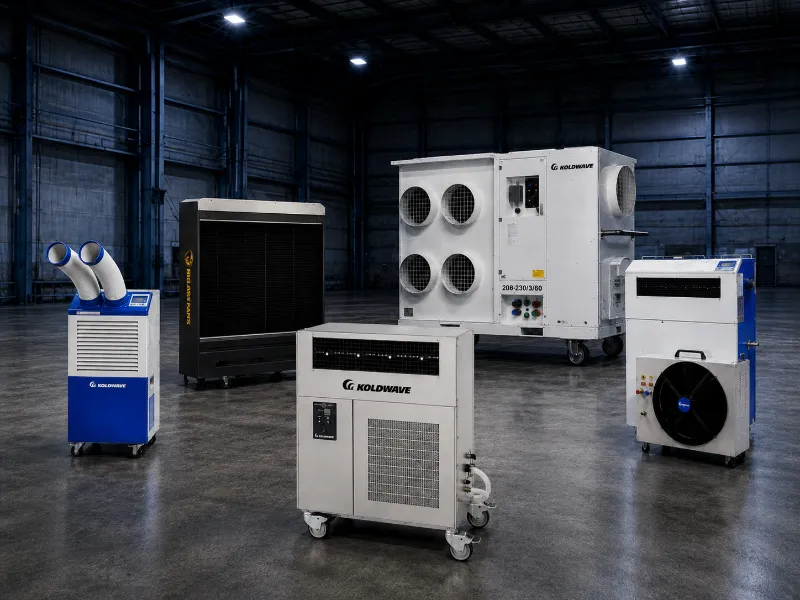
When a temporary cooling need comes up, the instinct is often to call and ask for “a portable AC.” That’s a reasonable starting point, but portable air conditioning is a broad category that includes equipment with meaningfully different operating principles, ideal applications, and performance characteristics.
Getting the wrong type of equipment for the space doesn’t just mean suboptimal performance. It can mean equipment that runs continuously without achieving target conditions, workers or processes that remain at risk, and a rental cost that doesn’t deliver the result you needed.
The two most commonly confused options in temporary commercial and industrial cooling are spot coolers and portable air conditioners. They’re related, they’re sometimes used interchangeably in conversation, and they’re genuinely different tools.
Here’s how to tell them apart and how to determine which one your situation actually calls for.
What a Spot Cooler Does
A spot cooler is a portable, self-contained cooling unit designed to deliver conditioned air to a specific location rather than condition an entire space. It operates on the same refrigerant cycle as a standard air conditioner but directs its output through a flexible duct or directional vent aimed at a targeted area: a server rack, a workstation, a piece of equipment, or a defined work zone.
The exhaust, which is the hot air generated as a byproduct of the cooling cycle, is vented outside the space or to an adjacent unconditioned area through a separate duct. This keeps the cooled space from being offset by the heat the unit itself generates.
Spot coolers are designed for precision and portability. They can be repositioned as work moves through a space, deployed in areas where ductwork or building infrastructure makes traditional AC impractical, and used to address hot spots within a facility that has existing HVAC that isn’t keeping up in specific zones.
Spot coolers are the right choice when:
The cooling need is localized rather than room-wide. A server rack running hot in an otherwise climate-controlled data center. A production workstation in an industrial facility where the surrounding space is tolerable but one area is generating excessive heat. A piece of equipment that needs to stay within temperature range regardless of ambient conditions.
The space can’t be adequately sealed for whole-room cooling. Spot cooling doesn’t require an enclosed environment to function. It delivers conditioned air where it’s aimed, which makes it practical in warehouses, open bays, and partially enclosed areas where conditioning the entire air volume would be impractical or unnecessary.
Speed of deployment is the priority. Spot coolers are plug-and-play in most commercial power configurations. Setup is fast, repositioning is easy, and the cooling effect is immediate.
What a Portable Air Conditioner Does
A portable air conditioner is designed to condition the air in an entire defined space, working more like a traditional HVAC system in a self-contained, mobile unit. It draws in warm room air, passes it through a refrigerant cycle to remove heat and humidity, and returns conditioned air to the space.
Like a spot cooler, it exhausts hot air out of the space through a duct. But where a spot cooler is directing its output at a specific target, a portable AC is working to bring the ambient conditions of the whole room down to a target temperature and humidity level.
Portable air conditioners in commercial and industrial sizes range from small units suitable for job site trailers and offices to large-capacity systems that can manage significant heat loads in enclosed construction spaces, temporary facilities, and event environments.
Portable air conditioners are the right choice when:
The goal is conditioning the entire space rather than a specific target. Interior construction environments, enclosed offices without working HVAC, temporary facilities, event spaces, and facilities where worker comfort across the whole area is the objective all call for whole-room conditioning rather than targeted spot cooling.
The space can be reasonably enclosed. Portable AC systems need to work against a defined air volume to be effective. An open or partially enclosed space dissipates conditioned air faster than the unit can replace it, which means the system runs constantly without achieving target conditions. The more enclosed the space, the more effectively a portable AC performs.
Humidity control is part of the requirement. Portable air conditioners remove moisture from the air as part of the cooling cycle. In environments where high humidity is a material problem alongside temperature, the dehumidification function of a portable AC adds value beyond what spot cooling alone provides.
Where It Gets Complicated: Overlapping Applications
In some situations, the distinction between spot cooling and portable AC blurs, and the right answer is a combination of both or a different approach entirely.
A large warehouse distribution center, for example, might use spot coolers to protect temperature-sensitive picking stations and provide relief at specific workstations, while portable fans and air handlers manage overall airflow through the space. Trying to condition the entire building volume with portable ACs would be impractical, but doing nothing for the workers inside isn’t acceptable either.
A data center facing a cooling emergency might use a portable precision cooling unit to restore general room conditions while spot coolers address specific racks generating the highest heat loads.
A construction project in the finish phase might use a portable AC to condition an enclosed floor for paint and coating work while spot coolers address a mechanical room where equipment is running and generating localized heat.
The point is that equipment selection isn’t always a binary choice. Understanding the principles behind each type of equipment allows for a more flexible and effective deployment.
Evaporative Coolers: A Third Option Worth Understanding
In dry climates, evaporative coolers, sometimes called swamp coolers, offer a lower-cost alternative to refrigerant-based cooling for certain applications. They work by passing air over water-saturated media, using evaporation to drop the air temperature. They’re energy efficient, require no exhaust ducting, and can cool large open spaces effectively in low-humidity environments.
The critical limitation is climate dependence. Evaporative coolers add moisture to the air as part of the cooling process. In humid environments, they lose effectiveness rapidly and can actually worsen conditions for workers and moisture-sensitive materials. In dry markets like Utah, Arizona, Colorado, and
Idaho, they’re a practical option for many outdoor and semi-enclosed applications. In the more humid markets of Ohio, North Carolina, Oklahoma, and the Gulf Coast, refrigerant-based cooling is almost always the right answer.
If you’re in a dry market and budget is a constraint, evaporative cooling is worth discussing with a rental partner. If you’re in a humid market, it’s generally not the right tool regardless of cost.
Sizing Matters as Much as Selection
Choosing the right type of equipment is only half of the decision. Getting the sizing right is equally important and equally easy to get wrong.
Cooling capacity is measured in BTUs per hour, or tons (one ton equals 12,000 BTUs per hour). A unit that’s undersized for the space will run continuously without reaching target conditions. A unit that’s oversized may cool too quickly without running long enough to manage humidity, leaving a space that feels clammy even if the temperature is acceptable.
The variables that drive sizing include square footage, ceiling height, the number of people working in the space, the heat generated by equipment and processes, the insulation quality of the building envelope, and the outdoor temperature differential the system needs to overcome.
In commercial and industrial applications, these variables interact in ways that make rough estimates unreliable. A server room with a high-density rack configuration has a much higher heat load per square foot than an open office of the same size. A manufacturing floor with heat-generating equipment needs to account for that load specifically.
Getting sizing right before equipment is deployed saves time, money, and frustration during the rental period.
Asking the Right Questions Before You Rent
The conversation with a rental partner goes more smoothly and produces better outcomes when you can answer a few basic questions upfront.
What is the space being cooled, and approximately how large is it? Is the space enclosed, or is it open or partially enclosed? What’s generating the heat you’re trying to manage: people, equipment, processes, or ambient outdoor temperature? Is humidity part of the problem, or is temperature the primary concern? Is the cooling need targeted at specific equipment or zones, or is the goal general comfort for workers in the whole space? What power is available on site?
None of these require technical expertise to answer. They’re observation-level questions that allow a knowledgeable rental partner to recommend equipment that actually fits the situation.
At 1Source Rentals, this is the conversation we have before recommending equipment, not after. Our team brings experience across construction, industrial, healthcare, data center, and commercial facility cooling applications, and we size solutions to the environment rather than defaulting to whatever is easiest to deliver.
Whether your need is targeted spot cooling, whole-room portable AC, or a combination of both, 1Source Rentals has the equipment and the expertise to match the solution to the space. Contact a local representative to talk through what your application actually requires.