
Not every summer cooling problem is about comfort.
In some facilities, temperature isn’t a quality-of-life issue. It’s an operational requirement with hard limits. A server room that climbs above its thermal threshold starts shutting down equipment to protect itself. A hospital wing without reliable climate control creates patient safety concerns and disrupts sensitive medical equipment. A manufacturing facility running a heat-sensitive process can’t simply slow down and wait for conditions to improve.
These environments have something in common: the cost of a cooling failure extends well beyond inconvenience. Downtime in a data center is measured in revenue per minute. Equipment damage in a healthcare setting creates patient risk and replacement costs. A production shutdown in an industrial facility ripples through supply chains and delivery commitments.
Temporary cooling in critical environments isn’t a backup plan. For many operations, it’s an essential part of keeping the facility running through planned maintenance, unexpected failures, capacity gaps, and the kind of summer heat that pushes permanent systems past their limits.
Here’s what that looks like across three of the environments where it matters most.
Data Centers and Server Rooms
The cooling requirements of a data center are unlike almost any other commercial environment. Heat is the primary enemy of the equipment inside, and it’s generated continuously by the servers, networking hardware, and power infrastructure that make the facility function. Unlike an office building where the heat load is largely driven by people and sunlight, a data center generates its own heat at a rate that doesn’t slow down at night or on weekends.
The stakes of a cooling failure are equally continuous. Server equipment that exceeds thermal thresholds begins throttling performance to protect itself, and if temperatures continue to climb, it shuts down entirely. The cost of unplanned downtime for most data center operations is significant, and the risk of physical equipment damage from sustained heat exposure adds capital replacement costs on top of operational losses.
Several scenarios create cooling gaps in data center environments.
Primary cooling system failures are the most acute. When a CRAC unit or chiller supporting a data center goes down in summer, the temperature inside the space can rise to dangerous levels within an hour, depending on the heat load and the room’s thermal mass. Same-day deployment of portable precision cooling or spot coolers is the difference between a managed incident and an operational crisis.
Capacity overruns happen when equipment additions or density increases push heat loads beyond what the existing cooling infrastructure was designed to manage. This is increasingly common as AI-driven computing demands more power per rack than previous generations of hardware. Temporary cooling fills the capacity gap while permanent infrastructure upgrades are planned and installed.
Planned maintenance and equipment replacement takes cooling systems offline on a defined schedule. Temporary cooling during these windows keeps the data center operational while the permanent system is serviced or replaced.
Hot spot management addresses the reality that heat distribution inside a data center is rarely uniform. High-density racks generate more heat than the surrounding infrastructure can always dissipate, and spot coolers positioned to deliver conditioned air directly to those racks provide targeted relief without requiring facility-wide changes.
At 1Source Rentals, data center cooling deployments start with understanding the specific heat load, rack layout, and existing infrastructure before recommending equipment. The right solution for a small server room is different from the right solution for a multi-row data hall, and getting that distinction right matters in an environment where the tolerance for error is low.
Healthcare Facilities
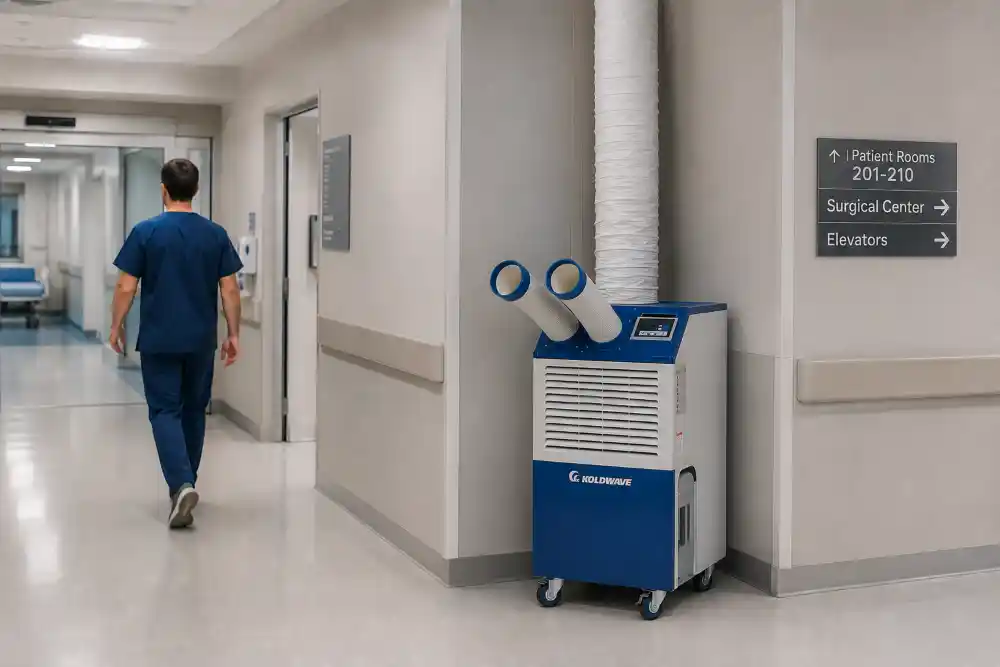
Healthcare facilities present a cooling challenge that combines the operational urgency of critical infrastructure with the human complexity of patient care environments.
Temperature and humidity control in a healthcare setting serves multiple functions simultaneously. Patient comfort and recovery are directly affected by ambient conditions. Sensitive medical equipment, including imaging systems, laboratory instruments, and pharmacy storage, has defined operating ranges that must be maintained. Surgical suites and procedure rooms require precise environmental control that standard backup cooling often can’t replicate.
When permanent HVAC systems fail or require maintenance in a healthcare environment, the response has to be faster and more carefully coordinated than in most other settings.
Emergency cooling for patient areas requires equipment that can be deployed without creating new hazards. Noise levels, airflow direction, electrical requirements, and infection control considerations all factor into how temporary cooling equipment is positioned and operated in active patient care areas.
Pharmacy and laboratory cooling protects temperature-sensitive medications, reagents, and biological samples that may be compromised by even brief exposure to elevated temperatures. In some cases, the loss of a single refrigerated storage environment creates patient care and regulatory complications that extend well beyond the immediate equipment failure.
Surgical and procedure suite support during HVAC maintenance requires solutions that can maintain the precise temperature and humidity conditions these environments require. This is a more specialized application than general facility cooling and benefits from a rental partner with experience in healthcare environments specifically.
Facility construction and renovation often disrupts existing HVAC zones in active healthcare buildings. Temporary cooling maintains safe and compliant conditions in patient areas adjacent to construction zones where permanent climate control has been compromised or interrupted.
Healthcare facilities that have established relationships with a temporary cooling partner before an emergency occurs are better positioned to respond appropriately. The time spent coordinating a first-time rental during an active patient care situation is time that matters.
Industrial Facilities and Manufacturing Operations
Industrial environments face a cooling challenge that’s distinct from both data centers and healthcare in one important way: the sources of heat are often the core of the operation itself.
Manufacturing equipment, process machinery, motors, compressors, and other industrial hardware generate heat continuously as a byproduct of operation. In summer, that internal heat load combines with elevated ambient temperatures to create conditions that affect worker safety, equipment performance, and production quality simultaneously.
Worker safety is the most immediate concern. Heat stress on production floors is a documented productivity and safety issue. Research published in Nature Cities found productivity losses of 29 to 41 percent in heat-stressed construction environments, and similar dynamics apply on manufacturing floors where workers perform physically demanding tasks in elevated temperatures. When permanent facility HVAC isn’t sufficient to manage peak summer conditions, supplemental cooling in worker zones directly affects both safety and output.
Process cooling addresses the equipment and material side of the equation. Many industrial processes have temperature requirements that affect product quality. Adhesives, coatings, plastics, and food products are all sensitive to temperature variations during processing. When ambient conditions push above process thresholds, temporary cooling maintains the environment the process requires.
Planned maintenance shutdowns create predictable cooling gaps that are easier to address than emergencies but equally important to plan for. When facility HVAC goes offline for scheduled service or replacement, production doesn’t necessarily stop. Temporary cooling maintains workable conditions for the crews completing the maintenance and for any processes that continue during the window.
Warehouse and distribution cooling focuses on protecting inventory and maintaining safe working conditions in large spaces where conditioning the entire air volume isn’t practical. Spot coolers at workstations, air handlers to improve overall airflow, and targeted cooling for temperature-sensitive storage areas all contribute to a safer and more productive summer operation.
Industrial process cooling for specialized applications, including manufacturing processes that require chilled water or controlled process temperatures, may require larger cooling infrastructure including portable chillers. These deployments are more complex than standard spot cooling and benefit from equipment sizing and system design expertise rather than a standard rental transaction.
What Critical Facility Cooling Requires from a Rental Partner
The common thread across healthcare, data center, and industrial cooling applications is that the margin for error is lower than it is for general commercial or construction cooling.
Equipment failures, sizing errors, and deployment delays that would be inconvenient in an office environment can have serious operational, financial, or safety consequences in critical facilities. That reality sets a higher bar for what a rental partner needs to provide.
Response time and availability matter. Equipment needs to arrive when the situation requires it, not when it’s convenient. That means 24/7 availability, regional inventory, and a team that can assess and deploy without a lengthy lead time.
Technical expertise matters. Recommending the right equipment for a data center hot spot is a different skill set than recommending general facility cooling. Partners with experience across critical facility types bring that distinction to the conversation.
Sizing and configuration matter. Equipment that’s undersized for the heat load doesn’t solve the problem. Equipment that’s poorly positioned or configured for the specific environment performs below its rated capacity. Getting both right requires experience, not just a product catalog.
At 1Source Rentals, our team works with healthcare, data center, and industrial clients across our markets to provide cooling solutions matched to the specific requirements of each environment. We bring equipment and expertise together, and we’re available when the situation is urgent.
If your facility has a cooling-critical application and you don’t have a temporary cooling plan in place, connect with a local 1Source Rentals representative now, before summer conditions put that gap to the test.