
When the AC Goes Down in Retail, Closing Isn’t an Option
A retail location doesn’t get to pause while the AC gets fixed.
Customers are already inside. Employees are processing orders. The afternoon heat is climbing. And the service contractor’s earliest available slot is two days out.
This is the scenario that plays out in retail and commercial facilities more often than most operations teams want to admit. HVAC systems fail during peak summer heat precisely because that’s when they’re working hardest. And in an occupied, customer-facing environment, the options narrow fast.
You can’t move the inventory. You can’t reschedule the customers. You can’t ask employees to work in conditions that compromise their safety and productivity. And closing, even temporarily, carries real costs in lost revenue, customer experience, and staff trust.
What you can do is deploy temporary cooling fast enough that none of those consequences actually materialize.
What a Retail AC Failure Actually Looks Like in Practice
When a national automotive parts distributor experienced an unexpected HVAC failure during peak operating hours at one of its retail locations, the situation called for a solution that could be up and running the same day in an active, occupied environment.
Rising indoor temperatures were already affecting the space. Customers were shopping. Employees were fulfilling orders at the counter and in the back. There was no window to shut down, clear the building, and set up equipment methodically.
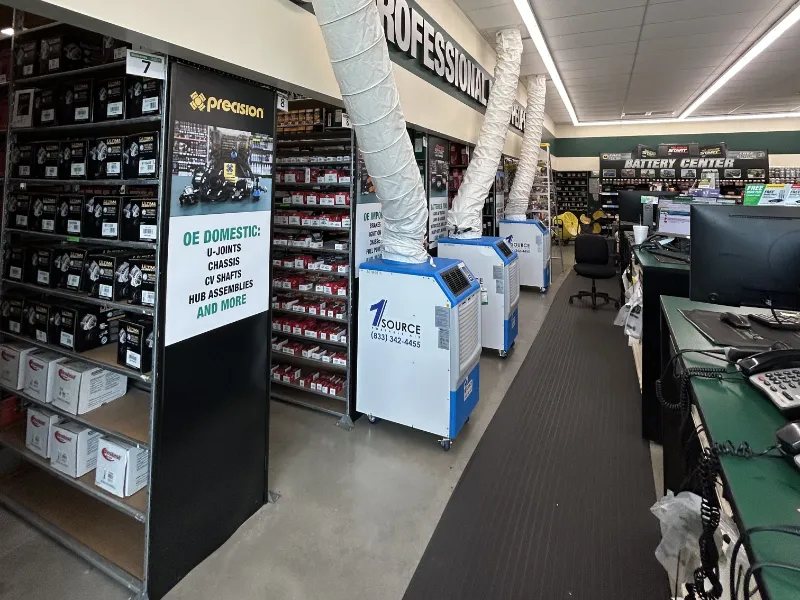
1Source Rentals responded with a turnkey deployment of six portable cooling units, a combination of standard portable one-ton AC units and a water-cooled portable air conditioner, strategically positioned to address customer-facing areas, employee workspaces, and critical operational zones simultaneously. Ceiling ducting removed warm air without creating obstructions in the retail environment, and setup was completed by experienced technicians with minimal disruption to the store’s normal operation.
The location stayed open. Customers stayed comfortable. Employees stayed productive. And the temporary cooling remained in place until permanent repairs were completed, providing a reliable bridge across the entire outage period.
The full project details, including equipment specifics, installation approach, and results, are available in the complete case study.
Read the Full Case Study: Maintaining Operations During an AC Failure at a National Automotive Parts Distributor
Why Retail Environments Are Particularly Vulnerable
Retail and commercial facilities face a specific set of challenges when HVAC systems fail that manufacturing or warehouse environments don’t.
The customer is present.
In a warehouse or industrial facility, an AC failure is an internal operations problem. In a retail environment, it immediately becomes a customer experience problem. Uncomfortable shopping conditions reduce dwell time, affect purchasing decisions, and create impressions that outlast a single visit.
The environment is occupied and active. Deploying temporary cooling in an empty space is straightforward. Doing it in a store with customers browsing, employees working the floor, and product displays and shelving throughout the space requires a more careful approach to equipment positioning, ducting, and noise management.
Closing is costly in ways that aren’t always fully calculated. Lost transaction revenue is the obvious number. But there’s also the cost of turning away customers who came specifically to that location, the reputational impact of a closed store during business hours, and the employee scheduling disruption that follows an unplanned closure. For locations with high foot traffic, those costs add up quickly.
Temporary cooling eliminates all of those consequences by keeping conditions workable for as long as the permanent system is out of commission.
The Response Time Factor
In an occupied retail environment, the cooling gap between HVAC failure and temporary solution deployment is when the real damage happens. Temperatures climb, discomfort sets in, and the decision to stay or leave gets made by customers before any intervention is possible.
This is why response time from a temporary cooling partner matters as much as the equipment itself. A solution that arrives the next business day is meaningfully different from one that arrives within hours of the call. For retail environments, the difference is measured in customer transactions and employee hours lost.
At 1Source Rentals, emergency response for commercial and retail cooling situations is part of how we operate. Our team is available around the clock, and our regional inventory is maintained to support same-day deployment in the markets we serve. We also handle the full installation, not just the equipment drop-off, because a portable AC unit sitting in a corner without proper positioning and ducting doesn’t solve the problem.
Portable Cooling in Retail: What the Right Deployment Looks Like
Not all temporary cooling deployments in retail environments are the same, and the approach matters as much as the equipment.
Customer-facing areas need cooling that feels invisible. Equipment positioned visibly in the middle of a sales floor creates a disruption that undermines the customer experience even as it addresses the temperature problem. The right deployment routes ducting discreetly, positions units in service corridors or near exterior walls, and directs conditioned air into occupied zones without making the equipment itself the focal point.
Back-of-house and operational areas have different requirements. Stockrooms, receiving areas, and employee break rooms may need their own cooling coverage separate from the retail floor, particularly when employees are performing physically demanding tasks in those spaces during summer heat.
Sizing to the space is critical. A single one-ton unit in a 5,000-square-foot retail environment isn’t going to move the needle on conditions. The right number and combination of units, matched to the square footage, ceiling height, occupancy, and heat load of the specific location, determines whether the temporary solution actually works or just gives the appearance of a response.
A water-cooled portable air conditioner, like the one included in the automotive parts distributor deployment, offers higher cooling efficiency in certain configurations and can be the right choice for larger or more heat-intensive areas within a retail space. Discussing the specific environment with a rental partner before equipment is selected produces better outcomes than defaulting to whatever is easiest to deliver.
The Broader Lesson for Commercial Facility Managers
The automotive parts distributor case illustrates something that applies across retail, hospitality, healthcare, and any other occupied commercial environment: the ability to respond quickly to an HVAC failure depends on having a plan and a partner before the failure happens.
Facilities that have identified a temporary cooling vendor, understand their basic equipment requirements, and have a contact they can reach at any hour are in a meaningfully better position when a summer HVAC failure occurs. The difference between a managed situation and a crisis is often just the lead time on making that first call.
If your facility or retail location doesn’t have an emergency cooling plan for summer, the case study linked below is a useful reference point for what a well-executed response looks like, and what it makes possible.
Read the full case study to see exactly how 1Source Rentals kept a national retail operation running through an unexpected HVAC failure.
Or connect with a local 1Source Rentals representative now to discuss what an emergency cooling plan looks like for your facility.