
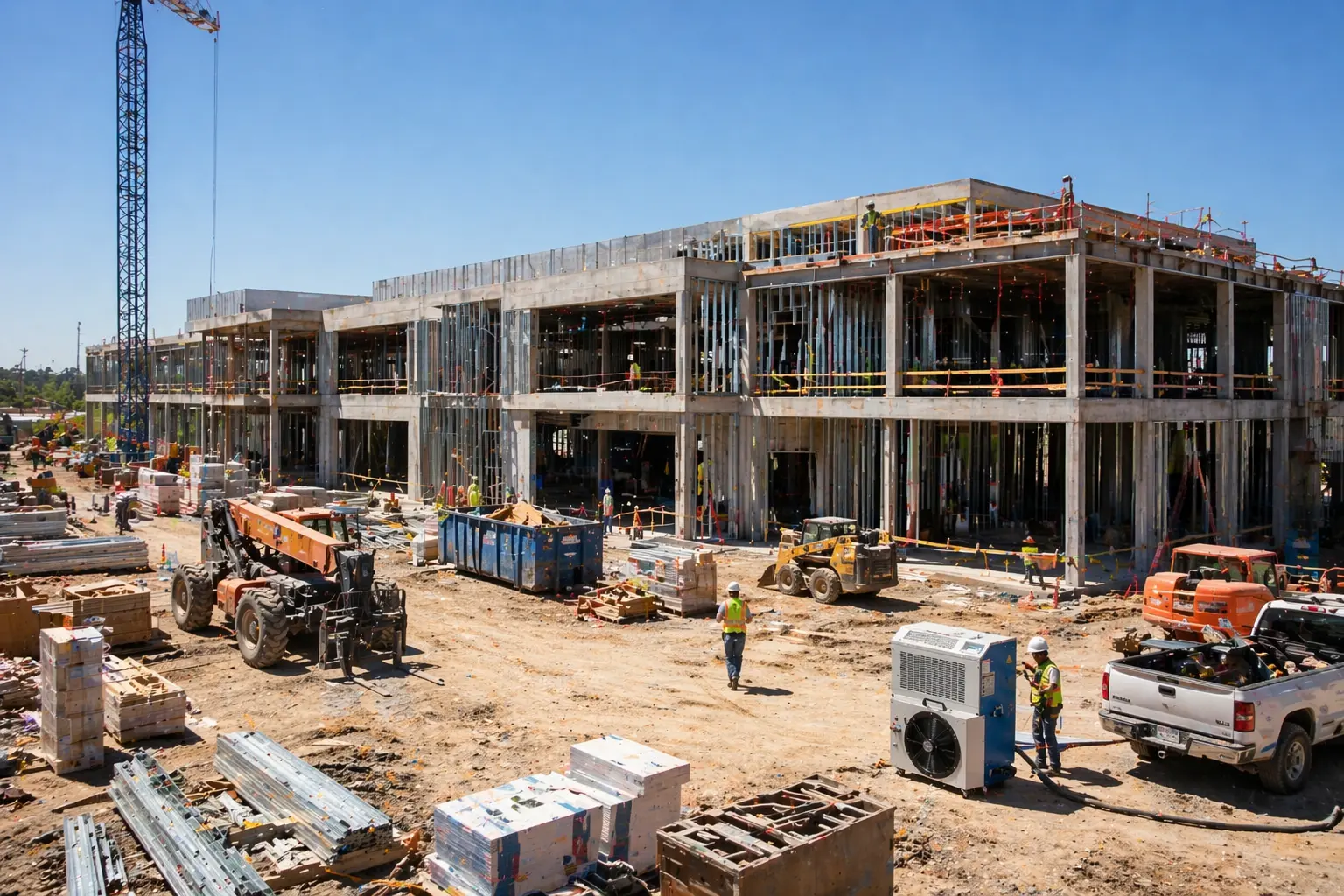
By the time a heat wave makes the news, the decisions that determine whether your job site is ready have already been made. Or they haven’t, and you’re making them under pressure.
That’s the part of summer heat planning that doesn’t get talked about enough. Temporary cooling equipment moves fast once the season turns. Demand spikes quickly, availability tightens, and the teams scrambling to source equipment in late June are working with fewer options and less lead time than the teams that planned in May.
This isn’t a scare tactic. It’s logistics. And it applies to every summer, not just the ones that make headlines.
Here’s what to know now, while there’s still time to act on it.
Why Summer Heat Is a Job Site Problem, Not Just a Weather Problem
Heat affects construction and industrial environments in ways that go well beyond worker discomfort. When temperatures climb inside an enclosed or partially enclosed space, the consequences show up in three places: people, materials, and timelines.
On the people side, the data is stark. Research published in Nature Cities found that heat stress is responsible for productivity losses of 29 to 41 percent on construction job sites. That’s not a rounding error. For a crew of 20 people, that’s the equivalent of losing six to eight workers for the day, every day conditions stay above threshold. And that’s before factoring in the health and safety implications.
Heat-related illness doesn’t announce itself with a warning. It builds gradually, affects judgment before it affects physical performance, and can escalate quickly in environments with limited airflow and no temperature regulation. Construction workers are among the most exposed populations in the workforce, and enclosed job sites without operational HVAC can reach temperatures well above ambient in a matter of hours.
On the materials side, summer heat creates its own set of problems. Coatings and adhesives applied in excessive heat cure too fast, compromising bond strength and finish quality. Flooring systems, sealants, and waterproofing products all have temperature application windows that get harder to hit when interior temperatures climb. Wood products expand. Slab temperatures rise. The finishing phases of a project, the ones with the tightest tolerances and the least margin for error, are the ones most sensitive to heat.
On the timeline side, those two factors compound. Crews slow down. Rework increases. Work stoppages during peak heat hours become necessary. Projects that looked well-paced in May start falling behind in July, and the cause often traces back to an environment that was never properly managed.
Temporary cooling is what closes that gap. Not by eliminating heat, but by keeping conditions inside the range where people and materials can perform as expected.
What This Summer’s Forecast Actually Means for Job Sites
Every summer brings heat. Some summers bring the kind of heat that changes how operations need to be run. This appears to be one of them.
The US is coming off the second warmest winter on record, a March heat wave that broke records scientists called “virtually impossible” without climate change, and a developing El Nino pattern that forecasters put at a 62% probability of emergence by June through August. That convergence matters because these are three independent drivers pointing in the same direction.
Understanding Heat Domes
A heat dome forms when a high-pressure system stalls over a region and traps warm air beneath it. The atmosphere acts like a lid. Temperatures that would normally moderate overnight stay elevated instead, and the cumulative effect over several days pushes heat indexes far above what daytime highs alone would suggest.
During the June 2025 heat dome that settled over the Central and Eastern United States, nearly 160 million people experienced temperatures exceeding 100 degrees Fahrenheit, with cities from Boston to Philadelphia recording their hottest temperatures in over a decade. That event happened with La Nina still the dominant climate pattern. The shift toward El Nino this summer introduces additional heat forcing on top of an already warm baseline.
For job sites, heat domes are particularly disruptive because they don’t follow the normal daily rhythm that crews plan around. The expectation that early mornings and evenings will be manageable breaks down. Overnight recovery diminishes. Back-to-back hot days accumulate in ways that a single-day temperature reading doesn’t capture.
El Nino’s Regional Impact on Job Sites This Summer
Above-normal temperatures are forecast across the western, northwestern, and southern United States this summer. The southern tier, already the most heat-exposed construction market in the country, faces the most acute risk. But the El Nino transition also brings increased humidity to parts of the Midwest and more volatile temperature patterns to the East Coast, where construction activity tends to accelerate significantly in the summer months.
No region is insulated from summer heat risk this year. The markets that feel it earliest will feel it longest.
The Equipment Side of Summer Readiness
Temporary cooling for construction and industrial environments isn’t a single category of equipment. It’s a set of tools matched to specific applications, and the right combination depends on the space, the work being done, and the conditions in the area.
Portable air conditioners are the most direct solution for enclosed spaces. They pull warm air through a refrigerant system and exhaust heat outside the work area, actively lowering interior temperature. They’re well suited for spaces where crews are working on finish phases and where material performance depends on stable conditions.
Spot coolers provide targeted cooling in specific areas of a larger space. They work well for equipment rooms, server areas, workstations, and localized comfort zones within a job site that isn’t fully enclosed. They’re fast to deploy and easy to reposition as work moves through the space.
Air handlers and ventilation equipment address the airflow side of heat management. In spaces where temperature is elevated but full air conditioning isn’t practical or necessary, moving air reduces the felt temperature and removes humidity that compounds heat stress. Combined with spot cooling, they extend coverage without the full infrastructure of a larger AC system.
Industrial cooling for facilities takes a different form. Manufacturing environments, warehouses, and process facilities often require cooling that integrates with existing systems or addresses specific process temperatures rather than general comfort. Chillers, cooling towers, and larger air handling units serve these applications.
The selection process matters as much as the equipment itself. A spot cooler sized for 500 square feet in a 5,000-square-foot open bay isn’t going to move the needle on crew conditions. And a large portable AC exhausting into an insufficiently vented space will underperform regardless of its rated capacity.
Getting the right equipment for the right environment is the conversation worth having in May, before the season is already underway.
The Lead Time Problem Nobody Talks About
Here’s a practical reality that affects every summer cooling plan: equipment availability is not a constant.
Temporary cooling rental inventory is regional and finite. As summer demand builds, the equipment closest to your market gets committed. Teams that move early have access to the full range of options for their space and application. Teams that wait until conditions are already critical are often working from whatever is left.
This is especially relevant for larger or more complex applications. A spot cooler for a job trailer can usually be sourced quickly. A coordinated cooling solution for an active industrial facility or a multi-floor interior construction environment requires planning, sizing, and logistics that can’t be compressed into 48 hours.
Beyond availability, lead time matters for installation and setup. Equipment that arrives on site needs to be positioned, connected, and running before conditions become a problem, not after. The difference between a proactive rental and a reactive one is often measured in days of lost productivity or, in worse cases, a heat-related incident that was entirely preventable.
The right time to have this conversation is when you still have time to plan it well.
Summer Readiness Looks Different at Every Phase
One thing that makes summer cooling planning more nuanced than winter heating is that construction projects move through significantly different environments over the course of a single summer.
In May and early June, projects that are still in structural phases have different needs than projects entering finish work. Open or partially enclosed sites move air naturally. Fully enclosed buildings with no HVAC running trap heat rapidly.
By mid-summer, the calculus shifts again. Crews are deep in finish phases. Painting, flooring, millwork, and mechanical trim-out are all happening simultaneously in spaces that may now be fully sealed. The cooling requirement at that stage is both more critical and more demanding than it was at framing.
Industrial facilities have their own seasonal pattern. Planned maintenance shutdowns often happen in late spring precisely to avoid the peak heat window. But facilities that run through summer need to account for process cooling, equipment protection, and worker conditions as ambient temperatures climb.
Rental solutions work well in this environment because they flex with the project. Equipment comes on site when it’s needed, scales to the phase, and comes off site when conditions or scope change. There’s no permanent infrastructure to maintain and no equipment sitting idle through seasons when it isn’t needed.
Planning for Summer Starts Now
If your project or facility is heading into a busy summer, the questions worth asking in May are straightforward.
What phases will be active during the hottest months? Will spaces be enclosed before permanent HVAC is operational? What are the material performance requirements for the finishing work scheduled for July and August? Are there industrial processes or equipment that need controlled temperatures to run safely?
The answers to those questions drive the equipment conversation. And that conversation is considerably easier to have in May than in July.
At 1Source Rentals, we work with construction and industrial teams to plan temporary cooling solutions before summer demand peaks. Whether your project is just entering the heat-sensitive phase or your facility needs a plan for the months ahead, our team can help you identify the right equipment for the space and the season.
Connect with a local 1Source Rentals representative to discuss your summer cooling needs before the season arrives.